
Rate code activation
Most abstract neural network (ANN) models use a floating-point activation value to represent something like the overall firing rate of a biological neuron. This was the case in the Leabra model, prior to the development of the discrete spiking Axon model, for example.
The rate code approximation can be an important way of simplifying the complexity of a model, and it is consistent with the reliable finding that the overall rate of firing of biological neurons does correlate well with the behavior and inferred internal representations in a large number of electrophysiological recordings. However, there is no doubt that it is an approximation to how the actual system behaves, and there are a number of potential costs to using such an approximation across various levels of analysis (Brette, 2015).
As emphasized in the neuron chapter, discrete spiking has advantages in representing graded, probabilistic information, while also supporting a fast initial propagation of new stimulus information via the first spike responses of neurons. By contrast, rate code neurons, at least with the additional biologically motivated properties of the Leabra model, could either respond quickly but in a not very graded manner, or slowly and with graded responding.
Furthermore, discrete spiking creates gaps between these spike communication events that enable other inputs to influence a given receiving neuron, and for the network overall to alternatively represent different interpretations of an input. By contrast, rate-code neurons are continuously communicating their signals, which makes them more monolithic and rigid in their responding. This difference is evident in the stable activation mechanisms required for spiking, but not rate code activations. Overall, it means that spiking networks are better at integrating disparate inputs and generating a sensible graded response to ambiguous signals.
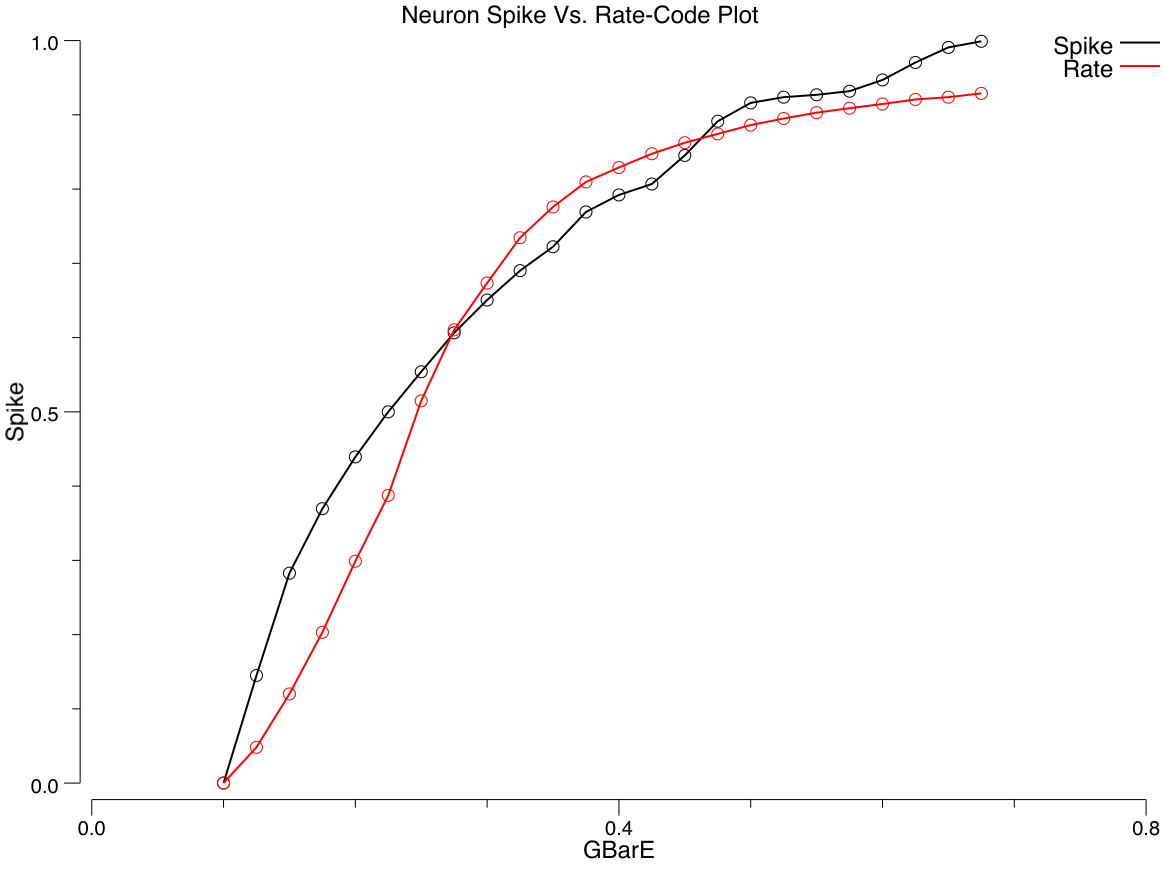
Figure 1: Quality of the rate code approximation (rate line) to actual spiking rate (Spike line), over a range of excitatory input levels (GBarE). The rate code approximation is based on the “gelin” (linear in Ge) model comparing \(Ge\) to \(g_e^{\Theta}\), using the Noisy XX1 sigmoidal function, and also including spike rate adaptation as included in the AdEx model.
Figure 1 shows the match between the Leabra rate code approximation and the actual rate of spiking in the AdEx discrete spiking equations used in Axon. Conceptually, we can think of this spiking rate as reflecting the net output of a small population of roughly 100 neurons that all respond to similar information. The neocortex is organized anatomically with microcolumns of roughly this number of neurons, where all of the neurons do indeed code for similar information. Use of this rate code activation enables smaller-scale models that converge on a stable interpretation of the input patterns rapidly, with an overall savings in computational time and model complexity.