
Hippocampus
The hippocampus is a set of interconnected brain areas in the medial temporal lobe, which is critical for episodic memory, which supports a significant role in spatial memory (memory for different spatial locations). In effect, as in physics, there is a strong connection between space and time in memory.
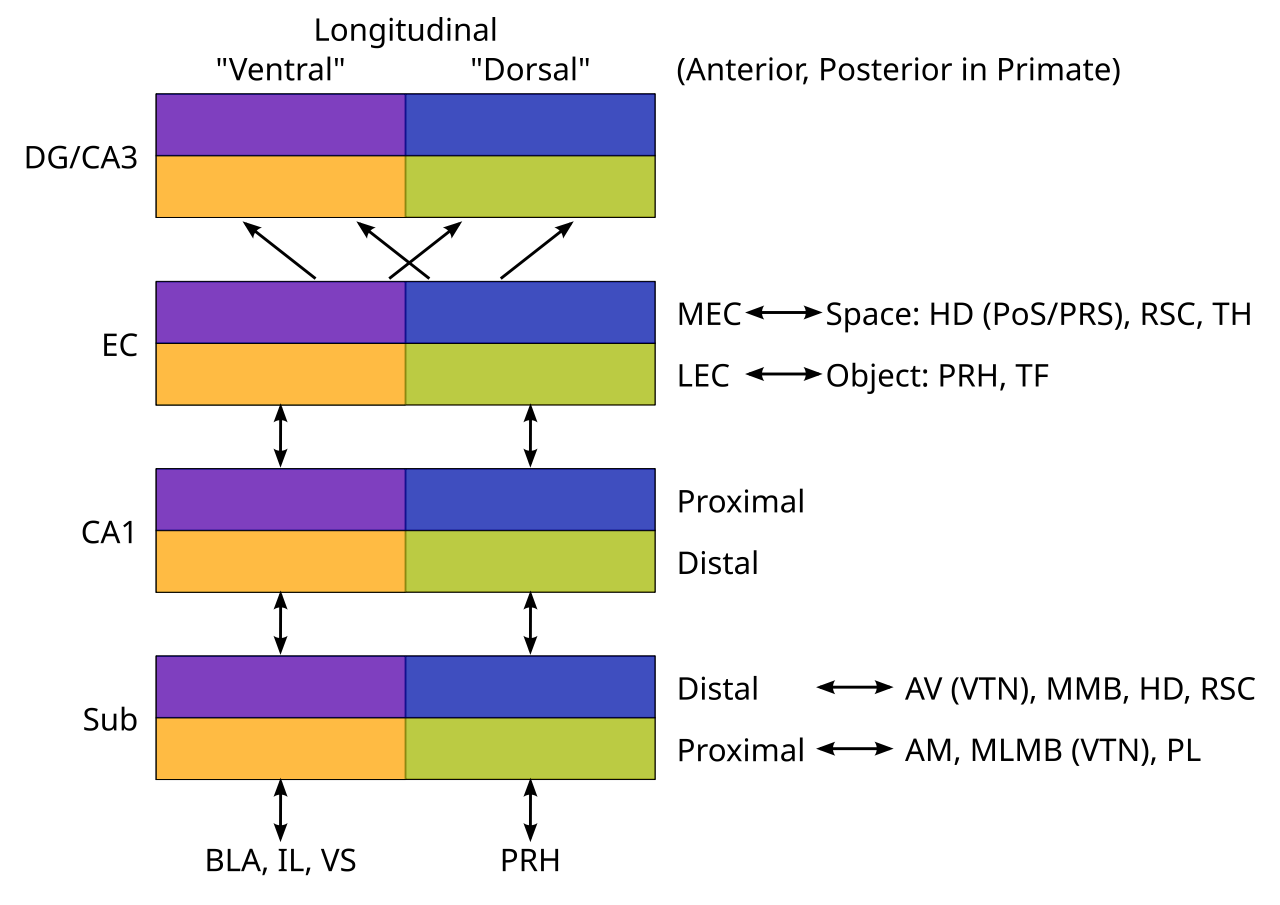
Figure 1: Two axes of topographic organization of the hippocampal system: the longitudinal axis that is consistent across all areas (ventral vs. dorsal in rodents, anterior vs. posterior in primates), and the distal vs. proximal axis within each area, which can flip depending on the area, as labeled. The longitudinal axis roughly maps onto the “limbic” goal / motivation (ventral) vs. sensory-motor (dorsal) division, while the other axis corresponds to the spatial (parietal lobe, including head direction (HD) and retrosplenial cortex (RSC)) vs. object (inferotemporal lobe; IT) tuning of inputs. Rodents do not have a specialized object-recognition pathway in IT, but nevertheless do have areas that are better at encoding object-based features, which are critical for landmark recognition. The core areas of the hippocampus in DG and CA3 bind together this object / landmark and spatial information, for both the goal-driven ventral networks, and sensory-motor dorsal networks.