
Eyeblink simulation
TODO: cerebellum simulation of airpuff eyeblink conditioning paradigm.
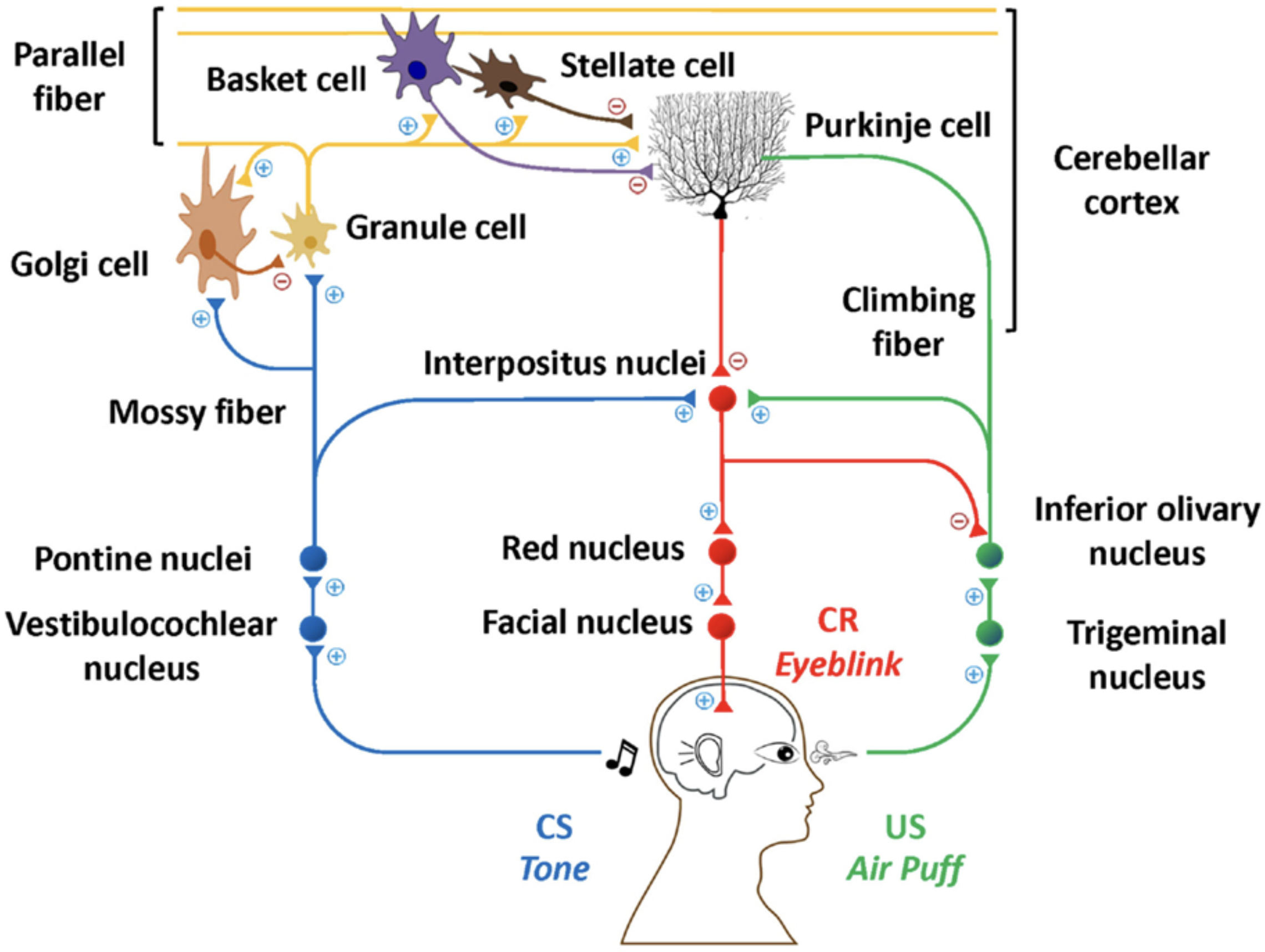
Figure 1: Delayed eyeblink conditioning and the functional role of different cerebellar circuits. The CS (conditioned stimulus) reliably precedes a noxious air puff (US, unconditioned stimulus), and learning enables the execution of the conditioned response (CR) of an eyeblink in response to the CS. The CS (tone) enters the cerebellum via the pontine nuclei, which give rise to the mossy fiber inputs to the cerebellar cortex. There is also a collateral to the interpositus (IP) nucleus, which is the cerebellar nucleus (CN) for this area. The air puff activates the IO (inferior olivary nucleus), which also receives inhibition from the IP. The CR is activated by inhibitory inputs from the Purkinje cells onto the IP. From Cheng et al (2015).
The early discovery that the cerebellum supports a form of classical conditioning (McCormick et al., 1982; McCormick & Thompson, 1984; Yeo et al., 1985; Mauk et al., 1986) has led to considerable progress in understanding the properties of the cerebellar system (Figure 1 from Cheng et al., 2015), but has also perpetuated considerable confusion about its direct motor involvement. Specifically the cerebellum is assumed to directly drive the conditioned response (CR) of a preventive eyeblink that protects the eye against the unconditioned stimulus (US) of a noxious air puff, in response to a conditioned stimulus (e.g., a tone).
This direct activation of the CR via the presumed disinhibitory drive from the cerebellar output is not obviously compatible with the purely sensory prediction learning assumed by the Nuclear model. However, many responses of PC and CN neurons recorded during conditioning were not compatible with the motor model (McCormick & Thompson, 1984; Berthier & Moore, 1986; Jirenhed et al., 2007; Green & Steinmetz, 2005), and instead were consistent with the sensory prediction model.
Specifically, most PC neurons recorded in this conditioning paradigm showed increases in simple spike firing immediately prior to the behavioral CR, not disinhibitory decreases. This is consistent with the sensory adaptive filtering model applied to the conditioning task, where the job of the cerebellum is to learn to predict the sensory US and CS onsets, and to then cancel the transient response to these stimuli as they become expected. Thus, increased inhibitory PC-driven cancelling activity is expected at the time of the expected air puff.
A later study (Halverson et al., 2015) specifically examined a subset of neurons that
TODO: IN recordings in (McCormick & Thompson, 1984; McCormick & Thompson, 1984), and Boele et al., 2010 results re amyg etc.