
Dopamine
Dopamine is a neuromodulator that modulates learning throughout the brain. It is secreted primarily by two adjacent brain areas in the brainstem, the ventral tegmental area (VTA) and substantia nigra pars compacta (SNc). From a computational perspective, activity of these dopamine neurons closely matches the behavior of the TD (temporal differences) reinforcement learning algorithm, which computes the reward prediction error (RPE; the difference between predicted and actual reward received).
From a biological perspective many different neural pathways converge on the VTA and SNc to drive the firing of dopamine neurons. The PVLV model provides a well-validated framework for understanding what each of these different pathways contribute, and is a core element of the broader Rubicon framework for goal-driven, motivated behavior.
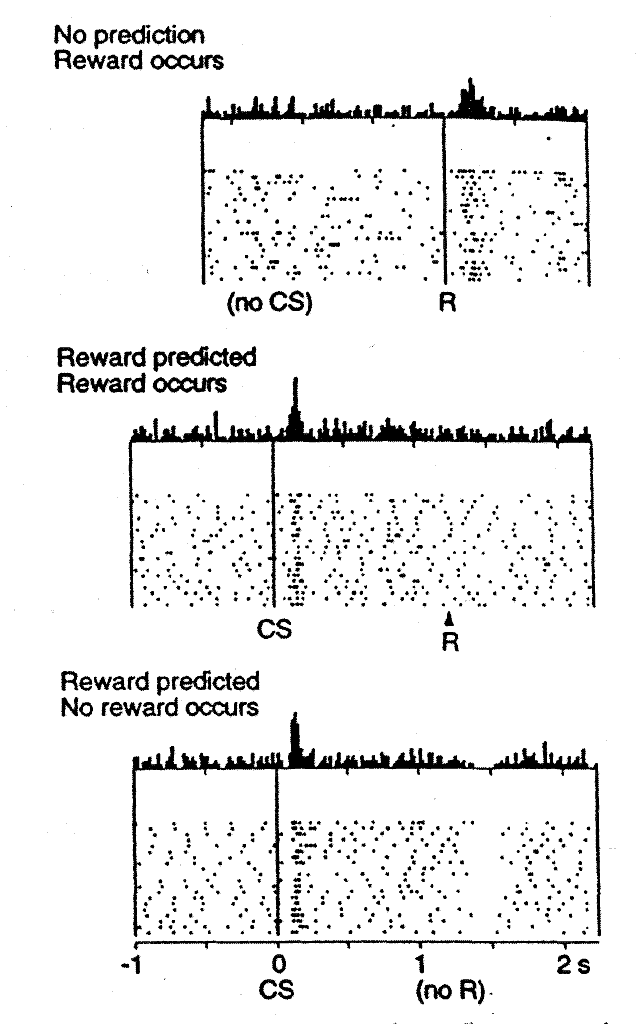
Figure 1: Characteristic patterns of neural firing of the dopaminergic neurons in the ventral tegmental area (VTA) and substantia nigra pars compacta (SNc), in a simple conditioning task (Schultz et al, 1997). Prior to conditioning, when a reward is delivered, the dopamine neurons fire a burst of activity (top panel — histogram on top shows sum of neural spikes across the repeated recording traces shown below, with each row being a different recording trial). After the animal has learned to associate a conditioned stimulus (CS) (e.g., a tone) with the reward, the dopamine neurons now fire to the onset of the CS, and not to the reward itself. If a reward is withheld after the CS, there is a dip or pause in dopamine firing, indicating that there was some kind of prediction of the reward, and when it failed to arrive, there was a negative prediction error. This overall pattern of firing across conditions is highly consistent with reinforcement learning models based on reward prediction error. Reproduced from Schultz et al, 1997