
Emergent
The classic scientific process of reductionism is typically dominant, where a complex system is reduced to simpler parts. However, one also needs to go in the opposite, oft-neglected direction, reconstructionism, where the complex system is actually reconstructed from these simpler parts. Often the only way to practically achieve this reconstruction is through computational modeling. The result is an attempt to capture the essence of emergent phenomena, where new levels of functionality emerge out of the interactions of simpler constituent elements.
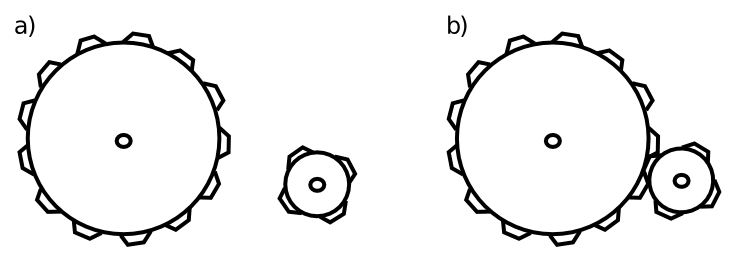
Figure 1: The principle of emergence, simply illustrated. The gears on the left do not interact, and nothing interesting happens. However, on the right, the interaction between the gears produces interesting, useful phenomena that cannot be reduced to the individual gears separately. For example, the little gear will spin faster, but the larger one will have higher torque at its axel — these properties would be entirely different if either gear interacted with a different sized gear. Furthermore, the material that the gear is made from really doesn’t matter very much — the same basic behavior would be produced by plastic, metal, wood, etc. Thus, even in this simple case, there is something just slightly magical and irreducible going on — when two gears get together, something emerges that is more than the sum of the parts, and exists in a way independent of the parts, even while being entirely dependent on actually having those parts to make it happen. This is a good analogy for the relationship between the mind and the brain, and computer models can capture many complex interactions between neurons in the brain, and reveal nonobvious kinds of emergence.
Emergence can be illustrated in a very simple physical system, two interacting gears, as shown in Figure 1. It is not mysterious or magical. On the other hand, it really is. You can make the gears out of any kind of sufficiently hard material, and they will still work. There might be subtle factors like friction and durability that vary. But over a wide range, it doesn’t matter what the gears are made from.
Thus, there is a level of transcendence that occurs with emergence, where the behavior of the more complex interacting system does not depend on many of the detailed properties of the lower level parts. In effect, the interaction itself is what matters, and the parts are mere place holders. Of course, they have to be there, and meet some basic criteria, but they are nevertheless replaceable.
Taking this example into the domain of interest here, does this mean that we can switch out our biological neurons for artificial ones, and everything should still function the same, as long as we capture the essential interactions in the right way? It is difficult to argue why this would not be the case, especially in light of the recent demonstrations of sophisticated emergent intelligent behavior in large language models.
Thus, when we finally manage to put enough neurons in the right configuration into a big computer simulation, it is unclear why the resulting brain would not then support consciousness and everything else, just like the ones in our own heads.
One interesting further question arises: how important are all the interactions between our physical bodies and the physical environment? There is good reason to believe that this is critical. Thus, we’ll have to put this brain in a robot. Or perhaps more challengingly, in a virtual environment in a virtual reality, still stuck inside the computer.